

Every Niagara Transit bus is fully accessible. Here’s what that means for your trip, and the help you can ask for.
Accessibility
Transit that works for every body.
On the bus
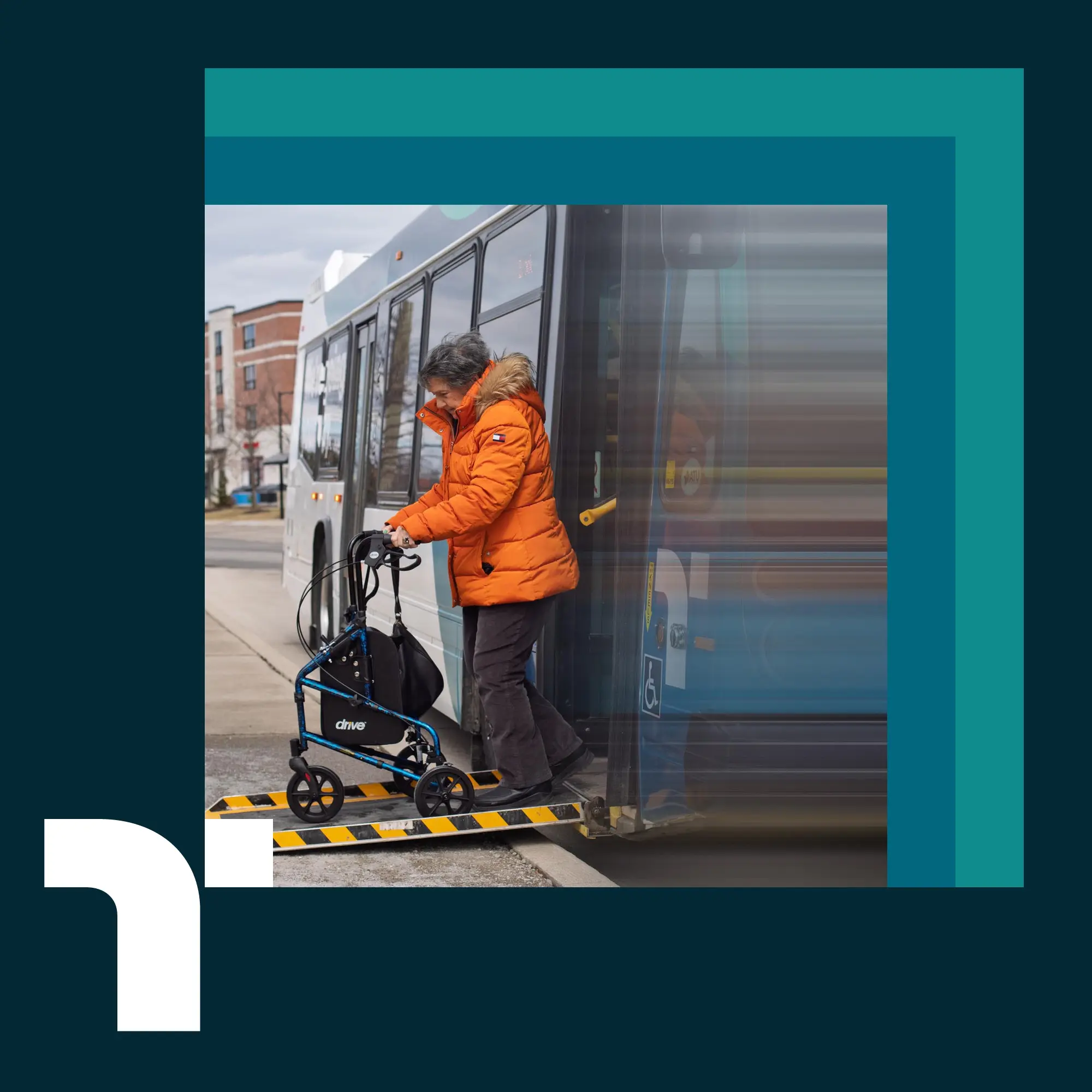
Every conventional bus is low-floor and fully accessible. Here’s what you’ll find on board.
- Priority seats
- Courtesy seats
- Wheelchair positions
- Speakers
Kneeling bus and ramp
The operator lowers the front of the bus and puts out a ramp, so you board on a gentle slope with a cane, walker, wheelchair or small scooter.
Priority and courtesy seats
Priority seats near the front door, marked with a blue decal, are for riders with disabilities. Courtesy seats nearby are for seniors, pregnant riders and adults with small children.
Stop announcements
Every bus announces the next stop out loud, by name and street.
Wheelchair area
A dedicated space with a stabilizer belt keeps you secure while the bus moves.
See it on video
Accessibility on Niagara Transit, 48 seconds. Turn on captions with the CC button in the player.
Video transcript
It’s important we can all get around Niagara. Here are some ways that we make Niagara Transit accessible to everyone.
Our buses can lower to curb level. This helps those with mobility issues who may have a harder time taking large steps to board.
A stop announcement system is an audible announcement for folks that are visually impaired. These are automated cues that inform passengers of when their stop is approaching.
Our visual destination signs are for folks with hearing impairments. This allows passengers to know how long they have until their stop and when it’s time to get off.
Service animals are welcome. Some passengers with visible and non-visible disabilities require use of a service animal.
Not all disabilities are visible, so be kind and be courteous to others. After all, transit is for everyone.
[Bright music]
Using the wheelchair area
Four steps with the stabilizer belt.
Need a hand?
Just ask. The operator will help you position and secure your mobility device, and give you time to get settled before the bus moves.
What operators do, on request
Operators are trained to help you travel safely.
Just ask, and the operator will:
- Put out the ramp for step-free boarding
- Give you time to board, be secured and get off safely
- Help secure your mobility device
- Welcome your medical aids on board
In an emergency
If a bus has to be evacuated, operators are trained to identify riders with disabilities and help them reach a safe place.
When a stop isn’t accessible
Sometimes a stop is blocked or unsafe for a while. Here’s what happens.
The stop is blocked or unsafe
Sometimes a stop can’t be used safely for a while.
The operator picks the closest safe spot
On the same route, even if it isn’t an official stop. Tell the operator what works for you: your preferences count.
We fix the barrier
Operators report it so it gets fixed. You can report one too.
Ride free
Two ways accessibility saves you a fare.
Your support person rides free
If you need a support person to travel on conventional or specialized transit across Niagara, they ride free with the Support Person Pass. The pass is free. A medical professional confirms the need on your application.
CNIB cardholders ride free
Riders who are legally blind ride free with their CNIB card, and so does their support person. Show your card to the operator.
Specialized Transit
Door-to-door service for riders who can’t use the bus.
If a disability stops you from using the bus, you may qualify for door-to-door Specialized Transit. Riders are approved ahead of time. Trained operators help you board, secure mobility aids and travel across Niagara.
- Wheelchair and scooter lifts
- Room for more than one mobility device
- Tie-downs and passenger seatbelts in vans
- Operators help secure and store mobility aids
- Certified guide dogs and service animals welcome
Formats and feedback
Information your way
Any rider information is available in large print, braille or audio. Tell us what you need and we’ll work with you on the format.
Tell us how we’re doing
Ran into a barrier, or have an idea? We want to hear it, and we’ll reply in the format that works for you. Or call 1-833-678-5463.
Questions
Short answers to what riders ask about accessibility.
Can I ask for the ramp if I don’t use a wheelchair?
Yes. The kneeling bus and ramp are there for riders with canes, walkers, wheelchairs and small scooters. Ask the operator.
Does my support person pay a fare?
No. With a Support Person Pass, your support person rides free on conventional and specialized transit across Niagara. CNIB cardholders and their support person ride free with the CNIB card.
How do I get information in large print, braille or audio?
Call 1-833-678-5463 or use the contact form and tell us what you need. We’ll work with you on the format.
What if my stop isn’t accessible?
The operator will let you on or off at the closest safe place on the same route, even if it isn’t an official stop, and will take your preferences into account.
What happens if the bus has to be evacuated?
Operators are trained to identify riders with disabilities and help them reach a safe location. This information is available in an accessible format on request.
Can I bring a service animal on Specialized Transit?
Yes. Certified guide dogs and service animals are welcome.
Need something we haven’t covered?
Call us, or tell us in writing. We’ll reply in the format that works for you.